Cycling back pain does not automatically mean you simply need to stretch more or sit more upright. Very often the back is showing that load, pelvic stability and cockpit support are not working together well enough on the bike.
You work directly with me, Lloyd Thomas. I assess how you take load through the pelvis and trunk and whether the bike is asking you to hold a position you cannot actually support for the duration of the ride.
How cycling back pain develops
Riding puts your spine in a single sustained position and then leaves it there. Unlike walking or running, where the back moves and unloads constantly, cycling asks the trunk to hold one shape while the legs work underneath it. Muscles that are good at short efforts are poor at holding still for three hours, and that is the load most riders are underestimating.
The mechanism that matters most is where the bend comes from. In a good position, the forward lean comes largely from the hips, with the pelvis rotating forward and the spine staying relatively neutral. If the hips cannot supply that rotation, whether because of mobility, a saddle that blocks it, or a reach that is simply too long, the lower back supplies it instead by rounding. It then holds that rounded position under load for the whole ride.
Upper back and lower back pain point in different directions
Riders search for both as back pain, but the causes rarely overlap and it helps to be specific.
Lower back pain, across the belt line or into the sacrum, is usually about pelvic rotation and hip mobility. It points at saddle height, saddle tilt, setback and how far you are reaching. Upper back pain, between the shoulder blades or at the base of the neck, is usually about supporting your upper body weight against the bar. It points at reach, bar height, bar width and how much of your weight is landing on your hands. The two often travel together, because a lower back that has run out of support pushes more weight forward onto the arms.
Common causes of cycling back pain
Back pain rarely comes from one number alone. Saddle position, reach, drop, handlebar height, cleats, foot support, mobility and ride duration can all combine to overload the back.
- saddle and cockpit are out of balance
- saddle tilted nose-down, so you slide forward and brace with the back
- pelvic stability breaks down under load, usually late in a ride
- hip mobility does not allow the forward rotation the position requires
- frame size or reach is not working cleanly
- foot and pedal setup create compensations up the chain
- a leg-length or saddle-height error that makes the pelvis rock
- you are riding too long in a position you cannot support well
Two typical patterns: the late fade and the immediate ache
Some riders are comfortable for the first hour or two and then deteriorate quickly, shifting position constantly and finding it hard to get comfortable again. That is an endurance pattern. The position is probably close to right but requires more support than you can currently hold, so the fix is often a mixture of setup change and honest load management.
Others hurt within the first fifteen minutes, every single ride. That is a mechanical pattern and it usually means something in the position is wrong rather than merely demanding: reach, saddle tilt, saddle height, or a bike that is the wrong size and has been made to work with parts.
Is cycling good or bad for your back?
For most people it is one of the better options, and this is worth stating plainly because many riders arrive having been told to stop. Cycling puts far less impact through the spine than running, keeps you moving, and lets you control intensity precisely. Riding with a history of back trouble is usually reasonable, and often actively helpful.
What cycling is not is automatically kind to your back. A poorly set-up bike holds you in sustained flexion for hours, which is a genuine load even though it is a gentle one. That is the difference worth understanding: the activity is rarely the problem, and the position frequently is. Riders who conclude that cycling hurts their back have often only established that their current setup does.
What you can check yourself before you book
A few observations help me place the pattern faster. You do not need to fix any of this, just notice it on your next ride:
- Is the pain low across the belt line, or higher between the shoulder blades?
- How far into the ride does it start, and does it ease when you stand up?
- Do you slide forward on the saddle and push yourself back repeatedly?
- Is your lower back rounded when you are on the bar tops, or does the bend come from the hips?
- Is it worse on long steady rides, or on rough roads and hard efforts?
None of this replaces an examination, but it usually already shows whether pelvic rotation or front-end support is the main story.
What I check and change during a back pain bike fit
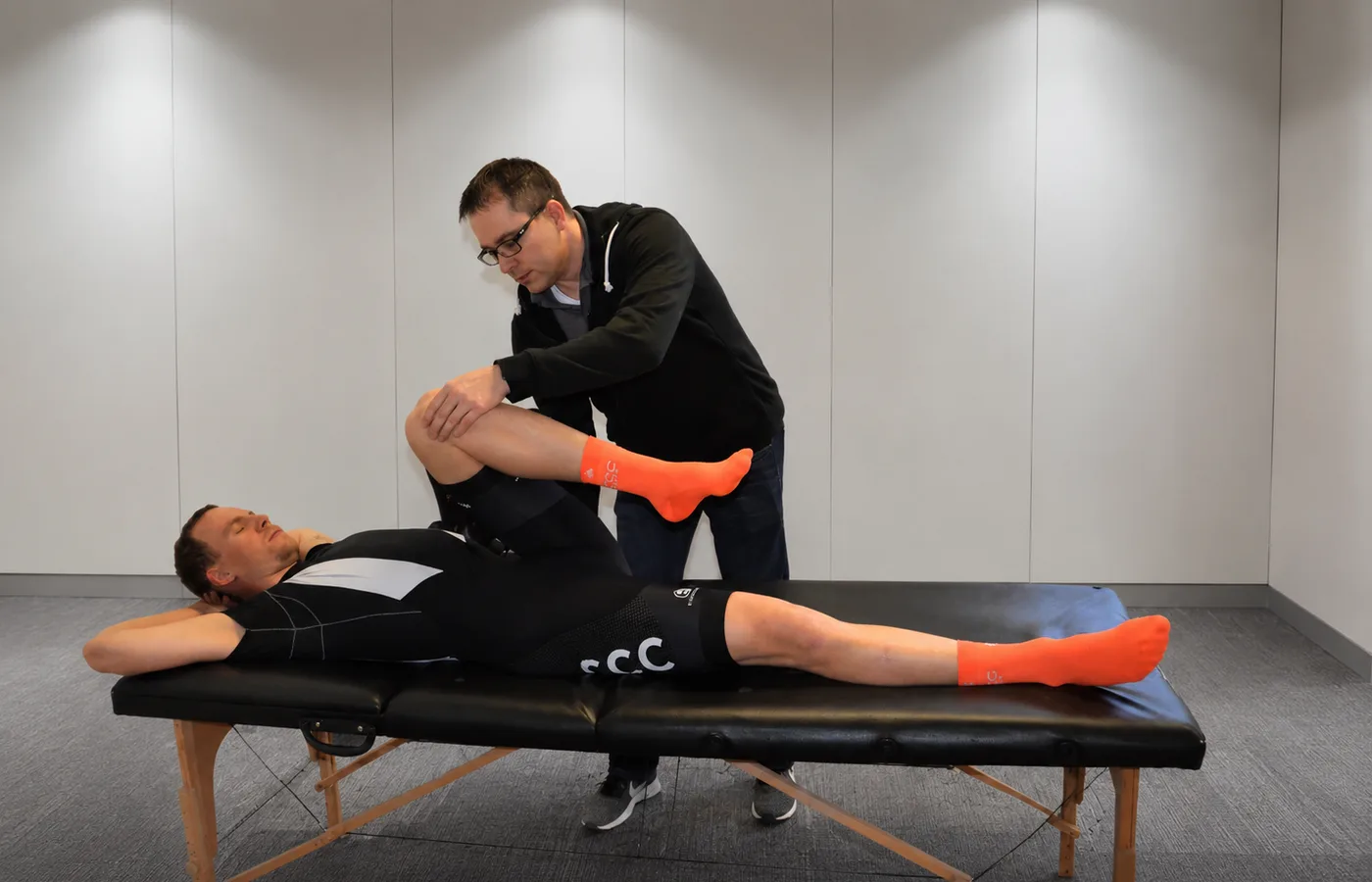
I start with off-bike movement and then analyse the position under load. I am not only asking where it hurts. I want to know why your system keeps overloading that area, and in particular whether your hips can deliver the rotation your position is demanding.
Typical levers are saddle tilt and setback so the pelvis can rotate forward, saddle height where rocking is adding load, and reach and bar height matched to the mobility you actually have rather than the position you think you should ride. The order matters. I identify the biggest lever first and make the changes that actually make sense for your bike and riding, because a back that is over-loaded will happily move the problem into the neck or hands if the balance is wrong.
- Cycling Neck Pain
- Cycling Numb Hands
- Cycling Piriformis Pain
- Stack and Reach
- Bike Fitting in Bensheim
When a bike fit helps and when medical assessment still matters
A bike fit is most useful when the bike or riding position is part of the load causing the symptom. It does not replace medical assessment, and back pain has a few signals that should go to a doctor first rather than to a fitter: pain radiating down the leg with numbness or weakness, numbness in the saddle area, any change in bladder or bowel control, pain after a fall or crash, pain that wakes you at night, or back pain that has nothing to do with riding.
A good adjustment should not only feel easier for a few minutes indoors. The bike should feel calmer outside and reduce stress on the back without simply moving the problem into the neck, hands or hips. That is why this page treats back pain as a load-distribution problem rather than as a single back-only issue.